
When Ontario winters descend on Kingston, Belleville and Cobourg, warm air from inside your home rises and condenses on cold attic surfaces. Without proper ventilation, that moisture can linger, leading to mould, rot and costly repairs. Knowing how to balance insulation and ventilation will keep your attic dry and your roof intact.
Why Winter Moisture Builds Up
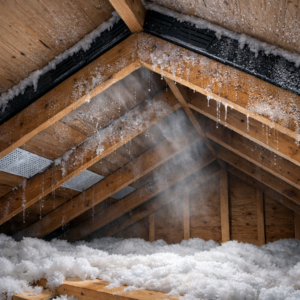
Condensation forms when warm, moist indoor air meets cooler surfaces like attic sheathing. During winter, warm air escapes from living spaces into the attic, condensing on nails, sheathing and rafters; if left unchecked, moisture can drip onto insulation and wood and promote mould. Canadian Home Inspection Services notes that condensation occurs whenever humid air contacts a cold surface. Because cold air holds less moisture, the vapor turns to liquid, forming frost on roof nails or damp spots around plumbing vents.
Proper Ventilation and Insulation
Adequate ventilation lets moist air escape and prevents ice dams. Walker Inspections advises that attic vents – soffit, ridge and gable – must remain open and free of insulation to allow airflow. Insulation also plays an important role; the attic should be five to ten degrees warmer than the exterior, otherwise heat loss can melt snow and create ice dams. The insulation should be thick, soft and dry; if it feels moist or compressed it can trap moisture and raise humidity.
Consider adding baffles at soffit vents to keep insulation from blocking airflow. A balanced system uses high (ridge) and low (soffit) vents: warm air exits high vents while cooler air enters through low vents. Without this high–low ventilation, attics stay warm and moist, increasing condensation.
Venting Appliances Properly
Homeowners sometimes vent dryers, bathroom fans or range hoods into the attic. This is a big mistake. All appliances should exhaust directly outdoors; otherwise moisture accumulates faster than ventilation can remove it. Regularly check that exhaust hoses and ducts haven’t become loose or detached.
Signs of Moisture Problems
Look for frost or water stains on roof sheathing, rusty nail heads, damp insulation or mouldy smells. Discolouration around recessed lights can indicate leaks. If you notice these signs, consult a Walker Inspections and we will use tools like moisture meters and thermal imaging to pinpoint the source.
Are you worried about attic condensation or ice dams? Walker Home Inspections can assess your attic insulation and ventilation using thermal imaging. We serve Kingston, Belleville, Cobourg and rural Eastern Ontario. Book an inspection today to protect your roof from winter moisture!
